
Parenting Education’s Impact on Families
The Power of Parenting™ Program: Research & Impact
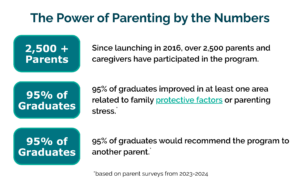
Program evaluation at Families First enables us to demonstrate impact and continually improve our programs to better serve families. Through the Power of Parenting program, parents build knowledge, skills, and support systems that help families thrive.
Evaluation of the Power of Parenting Program
Families First partnered with to study the impact of the Power of Parenting Program on parents and families. The Power of Parenting program is centered on the Five Protective Factors framework, which outlines factors that enable families to thrive and improve outcomes for We measured changes in protective factors and parenting stress for over 500 parents who participated in the Power of Parenting from 2020-2023.
Study Results
Parents who graduated from the Power of Parenting program demonstrated statistically in all five areas measured:


In contrast, parents who attended 0-4 sessions of the Power of Parenting program did not grow significantly in any of these areas.
This study’s results provide evidence of the positive impact of the Power of Parenting program on parents and families.
Identity Mapping
Identity Mapping is a qualitative evaluation tool woven into our parenting programs.
Parents are encouraged to use creative expression to reflect on how they see themselves as parents before and after the program.
The activity promotes both self-reflection and community building as parents share with one another how they have changed as a result of the program.
Identity maps allow us to see individual stories of change. Some key themes regarding parent change found with this tool are:
-
Increased parent confidence and enjoyment
-
Decreased parenting stress and frustration
-
Increased parenting knowledge (for example, positive discipline and improved communication with children)
-
Connectedness with other parents
Research that Informs the Power of Parenting Program
Extensive research has shown the vital role that parents can play in promoting the well-being of their children. At Families First, this research is the foundation of our parenting programs.
Families First’s programs have a positive impact on parents, children, and communities because:
Extensive research has clarified the vital role that parents can play in promoting the well-being of their children. At Families First, this research is the backbone of our parenting education programs.
80-90% of brain development happens in the first 5 years of life.
“In the first few years of life, more than 1 million new neural connections are formed every second.”
“The science on brain development is clear: To create the largest change, all signs point back to the child’s earliest years.”
16.2% of families in the Greater Boston area are living below the poverty line, compared to 11.5% across the United States.
75% of children from families with moderate-to-high incomes were prepared to enter kindergarten, compared to 48% of children from families living in poverty.
One stable and responsive relationship helps children overcome adversity.
Nine out of ten families surveyed by the Search Institute did not have the community and social connections needed to support their families.
“Families who struggle the most often have weaker social connections and supports. An opportunity, then, lies in strengthening the… social bonds—particularly with other families and parenting adults who share common priorities, challenges, and interests—so that families have trustworthy people they can turn to when they need more support or encouragement.”
“We should not underestimate the role of the parent and the power that comes from providing parents with information, resources and choice. Ensuring that parents have the knowledge and resources for providing a stimulating home environment is just as important, if not more important, as anything that happens in the classroom when children enter school.”
Families First’s programs have a positive impact on parents, children, and communities because…